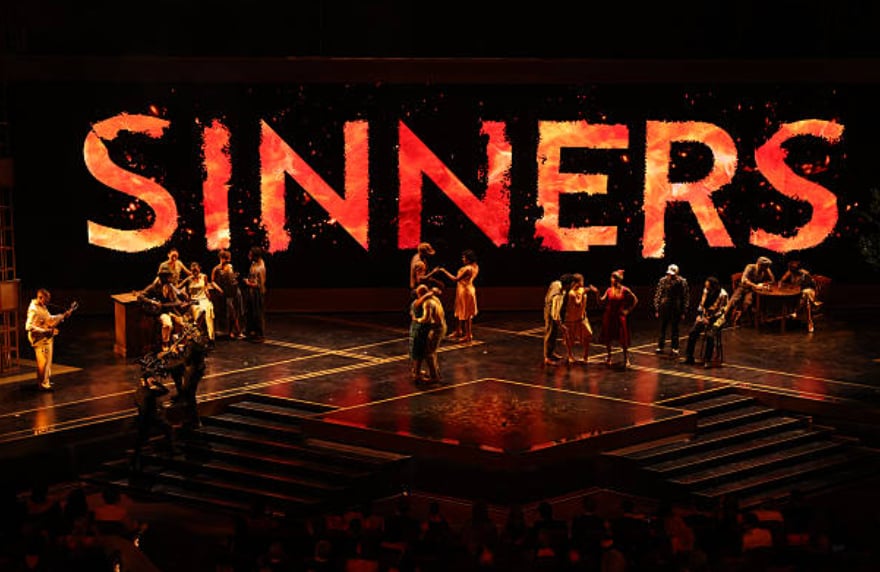
Black Storytelling: What “Sinners” Represents
By Sirius McDonell
Writer/Reporter
The tradition of storytelling isn’t a new practice. It has been around for hundreds, even thousands, of years. Through cave paintings, oral traditions and eventually scripture or ink-written pages, we have used storytelling to keep stories alive. While some may be metaphorical, using fictional creatures to keep certain ideas and morals alive, we also tell realistic stories. In African American culture, we have many stories that originated from our point of origin, Africa. However, we also have stories influenced by what we experienced in early America during slavery and, eventually, the Jim Crow era. While racism doesn’t define us, its extensive impact has been used to create stories that we can pass down and use to both cope with our history and have authentic discussions about it. With the popularity of Ryan Coogler’s 2025 film, “Sinners,” it opens the door for conversations about the importance of Black storytelling and what it represents.
“Sinners” and Black Storytelling
“Sinners” deeply explores what life was like in the 1930s as a person of color. We follow twin brothers Smoke and Stack as they purchase a building to establish a safe juke joint for people of color. There is only one rule: no white people. This creates tension when Remmick, the film’s primary vampiric antagonist, shows up and requests entry. We later find out that he was drawn to the twins’ juke joint after hearing and witnessing the powerful, connecting effect of the music that Miles Caton’s character, Samuel, can play. The film progresses as Remmick inflicts vampirism on some of the main cast, as well as others who attended the juke joint. It comes to a close when Remmick is defeated and Samuel survives. We then see Samuel decades later, with a successful career as a blues artist. At an older age, he reunites with Stack and his partner, Mary, who had both been presumed dead after the chaotic night many years earlier, when they were turned into vampires. They offer Samuel the gift of vampirism, which he refuses. They then wish him peace before leaving.
Black Storytelling and Resistance
Jessica Weingartner of Facing History & Ourselves wrote an article titled “Resistance and Black History.” It includes this quote from the Association for the Study of African American Life and History, or ASALH: “African Americans have resisted historic and ongoing oppression, in all forms, especially the racial terrorism of lynching, racial pogroms, and police killings since our arrival upon these shores. Black people have had to consistently push the United States to live up to its ideals of freedom, liberty, and justice for all.”
Ryan Coogler’s film masterfully navigates a series of hard-hitting themes that Black audiences can relate to and that non-Black audiences can learn from. By tackling survival despite the odds, perseverance through difficult times and resistance to oppression or oppressive systems, he can present to viewers how Black individuals have come so far by doing what we have had to do for hundreds of years.
Survival, Perseverance and Resistance
Survival has guaranteed our existence in the United States despite slavery and the torture that simply being Black brought. Perseverance has kept us here, determined to pave a way for better things despite racism and income inequality. Resistance to oppressive forces, such as Jim Crow laws in the 1900s, allowed us to put Black youth in schools and gave us the right to do something as essential as drink water from the same fountain as a white individual.
In more modern contexts, resistance has also played a large part since the 2020 killing of George Floyd. By highlighting the injustice of murder committed by an authority figure, Black communities held largely peaceful protests to speak up about how frequent wrongful and unprompted killings of Black individuals by authority figures are. By holding peaceful protests, prompting online discussions of injustice and race, and getting the world involved by recording these killings as they happen, we have been able to slowly curb the frequency of these incidents by holding those in power accountable.
Music and Meaning in “Sinners”
Outside of the film and what it opens in the realm of Black storytelling, the soundtrack also takes an in-depth look at the characters and setting of “Sinners” as a whole. The track “Dangerous,” sung by Hailee Steinfeld, is about the consequences of selfishness and what it means to be considered dangerous to another person. This highlights her character’s risky dynamic with Stack, as she was of mixed descent and light-skinned, presenting as a white woman to marry a white man.
She used this identity to protect her during a time when living and existing as a Black individual otherwise ensured a life of hardship, which it still does to varying extents today.
The track “Pale, Pale Moon” is a hypnotic song that uses chant-based elements and the dynamically pleasant voice of Jayme Lawson to focus on how badly her character, Pearline, wants simple things, such as being able to scream and be free. Rod Wave’s song “Sinners” melodically navigates the misfortune of unfulfilled promises that Black individuals have yet to see happen, such as being given 40 acres and a mule, a wartime order from 1865 by Union Gen. William Tecumseh Sherman. Each song on the soundtrack touches on or directly sings about themes of perseverance and yearning for more, further solidifying director Ryan Coogler and composer Ludwig Göransson’s artistic talents at conveying deep thematic elements through film and score.
Why Black Stories Matter
Discussing Black history and the culture that surrounds it is never easy, especially for Black storytellers. There are layers to it and a certain delicateness that needs to be used, which can make it challenging to find the proper execution. With the popularity of “Sinners,” I encourage you to watch more Black films if you would like to expand your view of Black culture.
Survival, Perseverance and Resistance
James Baldwin’s work showed our depth and vast expressions. He highlighted what a white cinematographer could not: the fact that we can be just as captivating on screen without having to play into stereotypes and enforce portrayals that harm the perception of Black men and women on screen. Director Kevin Willmott uses well-known movie genres as vessels to tell stories from the perspective of people of color. He dismantles and reshapes the idea that we can be in these situations and scenarios as centerpieces rather than on the sidelines.
We can be liberators. “Chi-Raq” explores Black women working to put an end to gun violence in Chicago. We can be detectives. “BlacKkKlansman” explores a Black man who infiltrates the KKK. We can be members of the military. “The 24th” explores an all-Black infantry regiment that revolts against discrimination by a white police force. We can do this without having our struggles and history censored for white audiences, minimized to compartmentalize our experiences or exploited for profit.
Exploring what Black writers have written and produced through an objective lens allows those outside of this minority to take previously underdeveloped beliefs and ideas and inform themselves. By gaining new threshold concepts, such as the dissection of privilege and how cultural identity is expressed in books and films, they can better understand not just what we write, but why it is important for it to be written and highlighted through film and music.
Share this content:










Post Comment