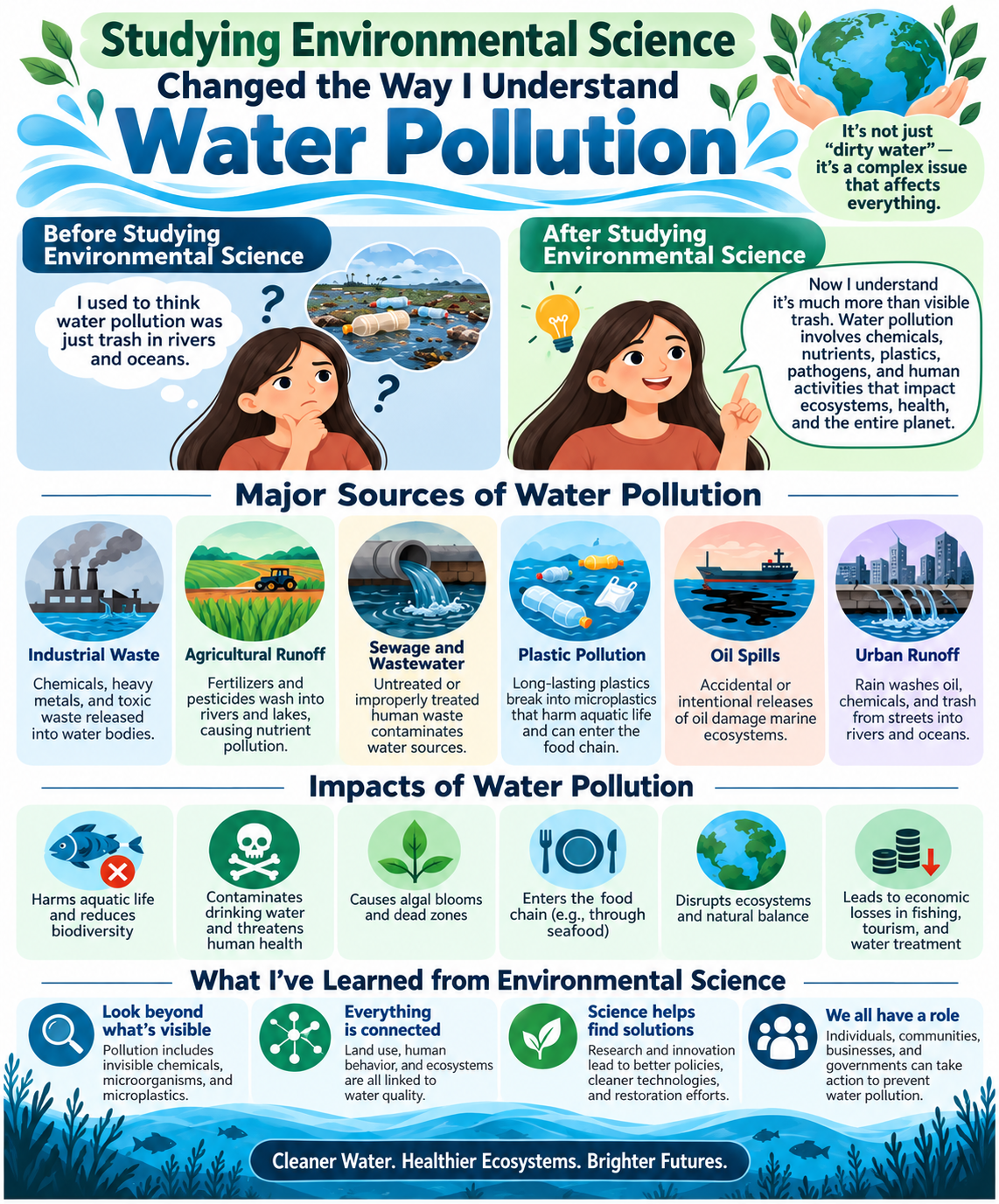
What Lies Beneath: Understanding Water Pollution Through Environmental Science
By Tasbiha Fatima Hasan
Writer/Reporter
When I began studying environmental science, I expected to learn about pollution, climate change, and ecosystems. What I did not anticipate was discovering how much environmental health depends on processes occurring beneath our feet.
Through my geology and environmental science coursework, I learned that water pollution is not simply about contaminants entering rivers or lakes. Groundwater depth, soil composition, bedrock characteristics, and geological history all influence how pollutants move through the environment.
One lesson particularly changed my perspective: Two places exposed to similar pollutants may experience very different consequences because of their geological and hydrological conditions.
Understanding Groundwater Vulnerability
Before studying groundwater systems, I primarily associated water pollution with visible contamination. However, groundwater is an essential resource that supplies drinking water, supports agriculture, and sustains ecosystems.
One important concept I encountered was the depth of the water table.
Where groundwater lies close to the surface, contaminants may reach it more easily, particularly when soils are highly permeable. Rainfall can transport dissolved fertilizers, pesticides, and other pollutants downward.
However, groundwater vulnerability depends on more than depth. Soil characteristics, rainfall, geological barriers, and pollutant chemistry also influence contamination risks.
Why Soil and Bedrock Matter
My geology coursework introduced me to the relationship between soil properties and contaminant movement.
Sandy soils generally allow water to infiltrate quickly, potentially transporting pollutants toward groundwater. Clay-rich soils often restrict infiltration and retain certain contaminants through adsorption.
Yet clay does not eliminate pollution risks. Reduced infiltration can increase surface runoff, carrying pollutants into nearby waterways.
Bedrock introduces additional complexity. Fractured formations may allow contaminants to travel rapidly, while less permeable formations can slow their movement.
I began to realize that the same geological characteristics that protect one water resource may create risks for another.
How Geological History Influences Pollution
Another fascinating concept was the influence of Quaternary deposits, particularly sediments formed through glacial and river processes.
Sandy alluvial deposits and glacial outwash can facilitate groundwater recharge but may also provide pathways for contamination.
In contrast, compacted glacial till containing fine-grained materials can restrict water movement.
These concepts helped me appreciate that geological events occurring thousands of years ago continue to shape environmental vulnerability today.
Connecting Natural Systems and Human Activities
Pollution susceptibility also depends on land use.
Agricultural fertilizers, industrial waste, urban runoff, and improper disposal practices can introduce contaminants. However, geological vulnerability does not automatically indicate existing pollution.
A highly susceptible aquifer may remain clean through responsible management, while less vulnerable areas can still experience contamination.
This distinction transformed how I interpret environmental maps. Rather than simply identifying vulnerable regions, I now ask what geological features, groundwater conditions, and human activities explain those patterns.
A Different Way of Seeing the Environment
My Environmental Science education has taught me that understanding water pollution requires connecting geology, hydrology, chemistry, and human activity.
What once appeared to be ordinary ground now represents an interconnected system influencing the movement and protection of water.
We cannot protect what we do not understand, and sometimes the most important environmental processes are those we cannot see.
As I continue exploring environmental science and data analysis, I hope to apply these lessons to identifying vulnerable areas, communicating environmental risks, and supporting evidence-based decisions.
Share this content:










Post Comment